

If you are a track and field or cross country athlete, you have probably asked yourself, “What performance do I need to go D1?” or “Is my PR good enough for a scholarship?” This page explains how college track and field recruiting standards really work and shows typical performance ranges for NCAA Divisions I, II, III, NAIA, and U SPORTS. Use it as a guide, not a guarantee. To see what your own performances can mean across every division, try our track and field recruiting calculator.
Read this first
The truth about college track and field recruiting standards
Most athletes and parents are given half the story. They see a list of times or distances and assume hitting that exact number means they will be recruited. That is not how college recruiting works.
1. Standards change constantly
The performances you need to be recruited by a given program are dynamic because:
- Rosters turn over every year
- Athletes graduate, quit, transfer, or get injured
- New athletes arrive with better PRs
- Conferences rise and fall in competitiveness
- New rules, such as Division I roster limits introduced in 2025, can alter the landscape significantly
A 400m performance that might have scored at a conference meet three years ago might not score there today. Standards are moving targets, not fixed rules.
2. Published standards are often wrong or outdated
Many team websites:
- Are never updated
- List old standards that no longer match the current roster
- Post inflated standards to reduce email volume
- Publish “walk-on” standards that do not reflect real recruiting decisions
If you rely only on published standards, you will misunderstand where you fit.
3. Coaches recruit to score at the conference level
This is one of the most important truths. Coaches do not recruit to hit a random time on a website. They recruit athletes who can help them score points at their conference championship, and eventually at national meets. That means:
- A “D1 level” 100m performance that does not score at a Power Four conference might be scholarship level in another conference
- A 400m hurdler who can score in a weaker conference may be more valuable there than a slightly faster sprinter in a deeper event at a stronger conference
- A coach might recruit a multi-event athlete who can cover several scoring opportunities instead of another pure specialist (versatility is key for Division I recruits)
If you can help a coach score at their conference meet, you are relevant to that program, regardless of what a static standards page says.
4. Division does not equal performance level
- There are NCAA Division II and NAIA athletes who would make Division I rosters
- Some Division III programs have event groups that could hang with mid-major D1 teams
- U SPORTS can overlap with D1 and D2 levels in certain events
5. Event depth, not just PR, affects your chances
In deeper events (for example men's 100m, women's 400m, elite distance), the gap between “good” and “recruited” can be brutal. In thinner events (for example steeplechase, hammer, and multi-events in some conferences), you can be slightly off the listed standard and still matter a lot.
Coaches build rosters across event groups. A 10.80 100m sprinter might have more or less value than a 47.xx 400m athlete depending on the conference and the team's current depth.
6. International and transfer recruiting changes the picture
- International athletes can raise standards quickly in some event groups
- Transfer portal additions can suddenly close a “hole” that existed last year
- Coaches sometimes hold spots for transfers, then pivot to high school athletes if those fall through
You cannot see all of this from the outside, which is another reason standards need to be understood as ranges and patterns instead of promises.
7. Training age and trajectory matter
Coaches look at:
- How long you have been training seriously
- Whether your PRs are improving consistently
- How much you have grown or changed physically
- Whether you play multiple sports or are already highly specialized
A 400m athlete going from 52.0 to 49.0 in one year with only two years of real training can be more interesting than someone stuck at 48.9 for two years.
8. Academics, budget, and location matter as much as PRs
- Strong grades can unlock academic scholarships and make a slightly lower performance more recruitable
- Some teams have more athletic scholarship money than others
- International tuition, out-of-state tuition, and residency rules change what a coach can realistically offer
Your performance is a big piece of your recruiting value, but not the only one.
Inside the process
How college coaches use standards
Performance standards are one tool in a larger process.
-
They assess their current roster and depth chart.
Where are they strong? Where are they thin? Which events need conference points next season?
-
They look at their conference and national picture.
What performances scored at conference last year? How many points do they need from each event group?
-
They build a list of “target profiles.”
For example: one 400m athlete who can score right away; one hurdler who can develop into a scorer in year two but contribute on relays right away; one jumper who can contribute in two events.
-
They match real athletes to those needs.
Performance standards help sort who might be ready now, who might develop, and who is not yet at that level.
Standards are a filter, not a verdict. They help answer questions like:
- “Will this athlete likely score for us in this conference?”
- “Is this athlete close enough that we can develop them?”
- “Does this athlete fit both our academic profile and our scholarship picture?”
Expert insight
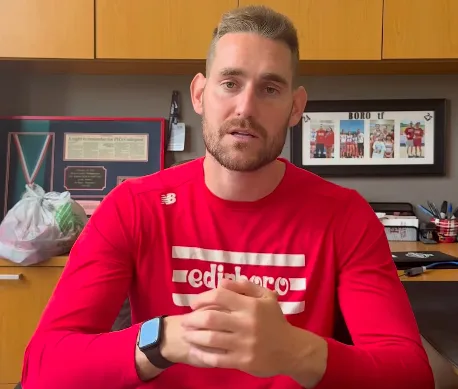
“Your marks might get you on a recruiting list, but your habits, attitude, and character can determine whether you stay on it.”

 Taylor Cudequest
Head Track & Field Coach, PennWest Edinboro
Our data
How we build these standards
Recruiting has changed more since 2021 than in the decade before it: roster limits, the transfer portal, NIL, and the end of test-score requirements (how recruiting changed). A standard is only useful if it reflects this recruiting cycle, so we build each range from multiple sources, then refine it with what we see every day working with both athletes and coaches. We update these standards as that feedback comes in, instead of scraping them once and posting them. Every summer we also check each range against the latest championship results and roll the page forward to the next two graduating classes, now the classes of 2027 and 2028.
- The fast end is at least what it took to finish 8th in the final at the toughest conference championship for that event, using multiple years of recent championship data. Coaches recruit to score at their conference meet, so this is the line that matters to them (the Conference-Impact Lens). Indoor events use indoor championship data.
- The other end is compared with the standards programs set on Streamline Athletes. Those change whenever a program changes theirs.
- High school distances (1600m, 3200m) are not run at college championships. We set the 1600m from the mile and the 3200m from the 3000m, using the same scoring we use across the platform. We compare them with what college coaches tell us.
- We also use direct conversations with college coaches in the NCAA, NAIA, and U SPORTS, verified performances on Streamline Athletes, and year-over-year trends.
These standards are not:
- Algorithmic guesswork
- Guarantees of recruitment opportunities or money
- Hard rules (coaches can and do recruit outside these ranges)
- Adjusted for your own event range, trajectory, academic standing, budget, or location and citizenship
These ranges represent:
- The performance levels that typically get recruiting interest
- The approximate thresholds where scholarships are realistic (see track and field scholarships by division for limits and how aid works)
- The general range where walking on or development roles become possible
By division
Recruiting standards by division
Ranges are for outdoor seasons unless they're in a table's Indoor group. Every range is for college hurdle heights and implement weights, shown under each event. Better performances in each range (faster, further, higher) usually line up with higher-level recruitment and scholarship potential. Lower performances often line up with walk-on opportunities or development recruits, especially outside the Power Four (ACC, SEC, Big Ten, Big 12).
NCAA Division I
The top end of each range suggests you'll be a top recruit with a strong chance at athletic scholarship offers at many schools. The bottom end suggests you could walk on at stronger programs or be recruited by lower-end programs, with scholarships less likely.
Power Four programs (ACC, SEC, Big Ten, Big 12) usually recruit closer to the faster end of these ranges, especially athletes who can score at their conference championships.
| Event | Performance range |
|---|---|
| Outdoor | |
| 100m | 10.2 – 10.8 |
| 200m | 20.6 – 21.7 |
| 400m | 45.9 – 49.0 |
| 800m | 1:47 – 1:55 |
| 1500m | 3:43 – 4:00 |
| 1600m | 3:59 – 4:18 |
| 3200m | 8:29 – 9:30 |
| 5000m | 13:40 – 15:20 |
| 10,000m | 29:12 – 32:00 |
| 110mH(42″ / 1.067 m)Profiles also take 39″ / 0.991 m and 36″ / 0.914 m | 13.8 – 15.7 |
| 400mH(36″ / 0.914 m) | 50.7 – 56.1 |
| 3000m steeple(36″ / 0.914 m barriers) | 8:41 – 9:30 |
| High jump | 2.18m – 1.95m |
| Pole vault | 5.40m – 4.50m |
| Long jump | 7.70m – 6.80m |
| Triple jump | 16.00m – 13.90m |
| Shot put(7.26 kg / 16 lb) | 20.20m – 16.00m |
| Discus(2 kg / 4.4 lb) | 57.00m – 45.00m |
| Hammer(7.26 kg / 16 lb) | 70.00m – 49.00m |
| Javelin(800 g / 1.76 lb) | 70.00m – 50.25m |
| Decathlon | 7700 – 6000 pts |
| Indoor | |
| 60m | 6.6 – 6.9 |
| Mile | 4:01 – 4:19 |
| 3000m | 7:55 – 8:53 |
| 60mH(42″ / 1.067 m) | 7.7 – 8.4 |
| Weight throw(35 lb / 15.88 kg) | 22.10m – 16.80m |
| Heptathlon | 5760 – 3900 pts |
| Event | Performance range |
|---|---|
| Outdoor | |
| 100m | 11.3 – 12.0 |
| 200m | 22.6 – 24.5 |
| 400m | 51.8 – 57.0 |
| 800m | 2:04 – 2:15 |
| 1500m | 4:13 – 4:40 |
| 1600m | 4:32 – 5:00 |
| 3200m | 9:43 – 11:47 |
| 5000m | 15:46 – 19:08 |
| 10,000m | 33:15 – 38:10 |
| 100mH(33″ / 0.838 m)Profiles also take 30″ / 0.762 m | 13.3 – 14.1 |
| 400mH(30″ / 0.762 m) | 58.0 – 1:01.5 |
| 3000m steeple(30″ / 0.762 m barriers) | 9:49 – 11:20 |
| High jump | 1.78m – 1.60m |
| Pole vault | 4.30m – 3.70m |
| Long jump | 6.50m – 5.60m |
| Triple jump | 13.20m – 12.00m |
| Shot put(4 kg / 8.8 lb) | 17.00m – 13.00m |
| Discus(1 kg / 2.2 lb) | 54.00m – 42.00m |
| Hammer(4 kg / 8.8 lb) | 63.00m – 45.00m |
| Javelin(600 g / 1.32 lb) | 53.00m – 37.00m |
| Heptathlon | 5750 – 4470 pts |
| Indoor | |
| 60m | 7.3 – 7.8 |
| Mile | 4:33 – 5:02 |
| 3000m | 9:02 – 10:57 |
| 60mH(33″ / 0.838 m) | 8.2 – 8.7 |
| Weight throw(20 lb / 9.08 kg) | 21.50m – 15.20m |
| Pentathlon | 4200 – 3060 pts |
NCAA Division II
| Event | Performance range |
|---|---|
| Outdoor | |
| 100m | 10.6 – 11.2 |
| 200m | 21.2 – 22.5 |
| 400m | 47.4 – 50.1 |
| 800m | 1:49 – 1:58 |
| 1500m | 3:47 – 4:10 |
| 1600m | 4:04 – 4:28 |
| 3200m | 8:45 – 9:32 |
| 5000m | 14:18 – 15:36 |
| 10,000m | 30:21 – 37:30 |
| 110mH(42″ / 1.067 m)Profiles also take 39″ / 0.991 m and 36″ / 0.914 m | 14.4 – 15.9 |
| 400mH(36″ / 0.914 m) | 52.3 – 60.4 |
| 3000m steeple(36″ / 0.914 m barriers) | 9:03 – 9:54 |
| High jump | 2.10m – 1.88m |
| Pole vault | 5.10m – 3.75m |
| Long jump | 7.60m – 6.60m |
| Triple jump | 15.40m – 13.60m |
| Shot put(7.26 kg / 16 lb) | 17.70m – 13.40m |
| Discus(2 kg / 4.4 lb) | 52.50m – 39.60m |
| Hammer(7.26 kg / 16 lb) | 60.00m – 39.00m |
| Javelin(800 g / 1.76 lb) | 65.00m – 39.95m |
| Decathlon | 6940 – 4550 pts |
| Indoor | |
| 60m | 6.8 – 7.1 |
| Mile | 4:05 – 4:30 |
| 3000m | 8:11 – 8:55 |
| 60mH(42″ / 1.067 m) | 7.9 – 9.0 |
| Weight throw(35 lb / 15.88 kg) | 20.00m – 12.95m |
| Heptathlon | 5300 – 2990 pts |
| Event | Performance range |
|---|---|
| Outdoor | |
| 100m | 11.8 – 12.8 |
| 200m | 24.2 – 26.9 |
| 400m | 54.9 – 59.6 |
| 800m | 2:08 – 2:25 |
| 1500m | 4:25 – 5:10 |
| 1600m | 4:44 – 5:34 |
| 3200m | 10:13 – 13:06 |
| 5000m | 17:00 – 21:10 |
| 10,000m | 35:09 – 44:25 |
| 100mH(33″ / 0.838 m)Profiles also take 30″ / 0.762 m | 13.7 – 16.5 |
| 400mH(30″ / 0.762 m) | 1:00 – 1:08 |
| 3000m steeple(30″ / 0.762 m barriers) | 10:27 – 14:11 |
| High jump | 1.70m – 1.50m |
| Pole vault | 3.80m – 2.80m |
| Long jump | 6.00m – 4.90m |
| Triple jump | 12.20m – 11.00m |
| Shot put(4 kg / 8.8 lb) | 15.50m – 10.00m |
| Discus(1 kg / 2.2 lb) | 50.00m – 30.50m |
| Hammer(4 kg / 8.8 lb) | 55.00m – 34.95m |
| Javelin(600 g / 1.32 lb) | 44.00m – 29.00m |
| Heptathlon | 4980 – 3000 pts |
| Indoor | |
| 60m | 7.5 – 8.2 |
| Mile | 4:45 – 5:35 |
| 3000m | 9:32 – 12:10 |
| 60mH(33″ / 0.838 m) | 8.7 – 10.2 |
| Weight throw(20 lb / 9.08 kg) | 19.00m – 10.95m |
| Pentathlon | 3700 – 2160 pts |
NCAA Division III
Unlike NCAA Division I and II programs, Division III track and field and cross country programs do not (and cannot) offer athletic scholarships. These ranges are not scholarship requirements; they are the performances many Division III coaches are looking to add to their rosters.
| Event | Performance range |
|---|---|
| Outdoor | |
| 100m | 10.8 – 11.4 |
| 200m | 21.8 – 23.5 |
| 400m | 47.9 – 52.0 |
| 800m | 1:54 – 2:02 |
| 1500m | 3:54 – 4:30 |
| 1600m | 4:11 – 4:50 |
| 3200m | 8:58 – 10:11 |
| 5000m | 14:47 – 16:45 |
| 10,000m | 30:48 – 35:15 |
| 110mH(42″ / 1.067 m)Profiles also take 39″ / 0.991 m and 36″ / 0.914 m | 14.7 – 16.3 |
| 400mH(36″ / 0.914 m) | 51.9 – 59.6 |
| 3000m steeple(36″ / 0.914 m barriers) | 9:14 – 10:25 |
| High jump | 2.05m – 1.84m |
| Pole vault | 4.80m – 3.25m |
| Long jump | 7.20m – 5.95m |
| Triple jump | 14.80m – 12.90m |
| Shot put(7.26 kg / 16 lb) | 16.20m – 12.00m |
| Discus(2 kg / 4.4 lb) | 50.50m – 37.00m |
| Hammer(7.26 kg / 16 lb) | 57.50m – 41.00m |
| Javelin(800 g / 1.76 lb) | 62.00m – 42.70m |
| Decathlon | 6580 – 4170 pts |
| Indoor | |
| 60m | 6.9 – 7.3 |
| Mile | 4:13 – 4:51 |
| 3000m | 8:22 – 9:30 |
| 60mH(42″ / 1.067 m) | 8.5 – 9.1 |
| Weight throw(35 lb / 15.88 kg) | 19.00m – 13.00m |
| Heptathlon | 4970 – 3210 pts |
| Event | Performance range |
|---|---|
| Outdoor | |
| 100m | 12.1 – 13.3 |
| 200m | 25.1 – 27.3 |
| 400m | 55.6 – 1:01.3 |
| 800m | 2:11 – 2:35 |
| 1500m | 4:33 – 5:12 |
| 1600m | 4:52 – 5:36 |
| 3200m | 10:26 – 13:06 |
| 5000m | 17:25 – 21:31 |
| 10,000m | 36:38 – 44:33 |
| 100mH(33″ / 0.838 m)Profiles also take 30″ / 0.762 m | 14.4 – 16.5 |
| 400mH(30″ / 0.762 m) | 1:01 – 1:12 |
| 3000m steeple(30″ / 0.762 m barriers) | 10:41 – 14:00 |
| High jump | 1.70m – 1.40m |
| Pole vault | 3.60m – 2.50m |
| Long jump | 5.60m – 5.00m |
| Triple jump | 11.70m – 10.20m |
| Shot put(4 kg / 8.8 lb) | 14.00m – 9.95m |
| Discus(1 kg / 2.2 lb) | 45.00m – 28.95m |
| Hammer(4 kg / 8.8 lb) | 53.00m – 34.95m |
| Javelin(600 g / 1.32 lb) | 41.00m – 31.00m |
| Heptathlon | 4490 – 3180 pts |
| Indoor | |
| 60m | 7.8 – 8.9 |
| Mile | 4:54 – 5:37 |
| 3000m | 9:44 – 12:10 |
| 60mH(33″ / 0.838 m) | 9.1 – 9.9 |
| Weight throw(20 lb / 9.08 kg) | 17.00m – 12.00m |
| Pentathlon | 3430 – 2110 pts |
NAIA
| Event | Performance range |
|---|---|
| Outdoor | |
| 100m | 10.7 – 11.4 |
| 200m | 22.0 – 23.1 |
| 400m | 48.6 – 50.9 |
| 800m | 1:55 – 2:05 |
| 1500m | 3:55 – 4:27 |
| 1600m | 4:12 – 4:46 |
| 3200m | 9:17 – 10:09 |
| 5K cross country | 15:05 – 17:45 |
| 10,000m | 32:09 – 37:30 |
| 110mH(42″ / 1.067 m)Profiles also take 39″ / 0.991 m and 36″ / 0.914 m | 14.6 – 16.8 |
| 400mH(36″ / 0.914 m) | 56.1 – 62.9 |
| 3000m steeple(36″ / 0.914 m barriers) | 9:21 – 10:02 |
| High jump | 2.08m – 1.83m |
| Pole vault | 4.80m – 3.25m |
| Long jump | 7.20m – 6.10m |
| Triple jump | 14.70m – 12.70m |
| Shot put(7.26 kg / 16 lb) | 16.80m – 11.70m |
| Discus(2 kg / 4.4 lb) | 50.00m – 33.00m |
| Hammer(7.26 kg / 16 lb) | 57.00m – 39.00m |
| Javelin(800 g / 1.76 lb) | 58.00m – 37.00m |
| Decathlon | 6500 – 4240 pts |
| Indoor | |
| 60m | 6.9 – 7.1 |
| Mile | 4:14 – 4:48 |
| 3000m | 8:41 – 9:28 |
| 60mH(42″ / 1.067 m) | 8.5 – 9.1 |
| Weight throw(35 lb / 15.88 kg) | 19.00m – 12.00m |
| Heptathlon | 4900 – 2990 pts |
| Event | Performance range |
|---|---|
| Outdoor | |
| 100m | 12.1 – 12.8 |
| 200m | 24.8 – 27.8 |
| 400m | 56.8 – 59.6 |
| 800m | 2:15 – 2:27 |
| 1500m | 4:35 – 5:10 |
| 1600m | 4:54 – 5:34 |
| 3200m | 10:54 – 12:23 |
| 5000m | 17:54 – 21:00 |
| 10,000m | 38:15 – 45:00 |
| 100mH(33″ / 0.838 m)Profiles also take 30″ / 0.762 m | 14.8 – 16.5 |
| 400mH(30″ / 0.762 m) | 1:04 – 1:14 |
| 3000m steeple(30″ / 0.762 m barriers) | 11:07 – 14:00 |
| High jump | 1.60m – 1.40m |
| Pole vault | 3.70m – 2.45m |
| Long jump | 5.70m – 5.20m |
| Triple jump | 11.50m – 9.00m |
| Shot put(4 kg / 8.8 lb) | 13.50m – 10.00m |
| Discus(1 kg / 2.2 lb) | 42.00m – 31.00m |
| Hammer(4 kg / 8.8 lb) | 51.00m – 35.00m |
| Javelin(600 g / 1.32 lb) | 40.00m – 30.00m |
| Heptathlon | 4470 – 3200 pts |
| Indoor | |
| 60m | 7.7 – 8.5 |
| Mile | 4:56 – 5:35 |
| 3000m | 10:09 – 11:31 |
| 60mH(33″ / 0.838 m) | 8.9 – 10.3 |
| Weight throw(20 lb / 9.08 kg) | 17.00m – 10.95m |
| Pentathlon | 3390 – 2040 pts |
Of the associations in these tables, only NAIA contests these events. The race walk is part of its championships (5,000m outdoors, and 3,000m indoors on the women's side), and the marathon has its own event, the NAIA Marathon Classic, held each December with men's and women's races. If you race walk or run the marathon, NAIA programs are the ones recruiting for it. Streamline Athletes profiles take race walk and marathon performances.
U SPORTS: men and women
U SPORTS recruiting standards vary widely across Canada West, OUA, RSEQ, and AUS, and across programs that prioritize different event groups. In general:
- Competitive U SPORTS performances often fall between strong NAIA and NCAA Division II levels
- Medal contenders in some events overlap with mid-major NCAA Division I athletes
- Standards shift heavily by event group and program goals
U SPORTS teams from coast to coast are actively recruiting on the Streamline Athletes platform. The best and fastest way to find out if you're a fit for university track and field or XC in Canada is to create your profile and see if coaches contact you.
Keep perspective
How to interpret these standards without losing your mind
- Being at the top end of a range does not mean you will “automatically” go D1 or get a full scholarship
- Being below the range does not mean you are un-recruitable
- There are athletes every year who beat these standards and still do not land where they expect
- There are also athletes who fall slightly below them and find great fits because of academics, personality, and development potential
- Use these ranges as a guide, not a verdict
- Focus on consistent improvement in your performances and grades
- Focus on finding schools where you can be happy, supported, and competitive
- Do not waste time trying to guess every coach's standard by yourself
Other sources
How these standards compare with other published standards
We looked at the other standards resources families find most often. Here is what each one publishes, how it describes its numbers, and what it does well. All of them, including us, offer recruiting services; here's how those services compare.
-
NCSA
PublishesOne top and one low standard for each division, for men and women. The page doesn't say how the standards are set or when they were last updated.
Does wellIts explanation of recruited and non-recruited walk-ons is one of the clearest we found.
-
Runcruit
PublishesRecruit, Walk On, and Tryout standards for each program, described as estimates from its prediction engine. Coaches can edit their own program's page.
Does wellAnyone can see the standards without an account.
-
Track and Field Standards (The Preferred Recruit)
PublishesA search tool that compares your performances with individual colleges. It covers outdoor events. Indoor events, multis, and cross country aren't included.
Does wellIt's quick, with no sign-up needed.
-
TNS Recruit
PublishesOne range per division, including JUCO, based on current rosters and recent recruiting classes.
Does wellA useful rule of thumb: be within 1–3% of the standard to be actively recruited.
-
Fast Track Recruiting
PublishesProgram pages for academically selective schools, including the Ivy League and NESCAC, from a founder who coached at Columbia for 20 years. It focuses on selective programs rather than every division.
Does wellIts guidance on what standards can and can't tell you is some of the most candid we found.
-
TrackThletics
PublishesOne standard per NCAA division for running events. Field events and NAIA aren't included.
Does wellOne number per event makes it quick to read.
-
Pathley
PublishesRanges for five events in four bands, from high-major D1 to D3, which it calls rough guidelines rather than hard cutoffs.
Does wellIt explains well how timing, wind, altitude, and indoor versus outdoor affect a performance.
-
VarsityBio
PublishesD1 split into elite, mid-major, and lower levels, and D2 into three levels. D3 appears for some events, and NAIA is described without numbers.
Does wellIt includes the decathlon and heptathlon.
How ours differ
On Streamline Athletes, program matching happens inside the platform, where grades are part of the match and the standards power Contact Coach and coaches reaching out to athletes. Our free recruiting calculator is open to anyone. We start from conference championship scoring, because that is the line coaches recruit to (the Conference-Impact Lens).
Check any of us against the source
Conference championship results on TFRRS and the standards a program posts on its own site are the primary sources. If a number here doesn't match what a coach tells you, trust the coach.
Get recruited
What to do next
-
Create your free Streamline Athletes profile
Add your basic info, academic info, and athletic performances. We verify your performances using official meet results so college coaches can trust your profile.
-
Complete your profile so coaches can evaluate you
Once your profile is complete and your performances are verified, you'll hear from programs where you're an athletic, academic, and geographic fit, within 24 hours. Programs recruiting on Streamline Athletes can contact you an unlimited number of times, on any plan.
-
Use Contact Coach on programs where you fit
Contact Coach appears on programs where your verified performances meet the program's standards. It sends your profile to the coach who recruits your events, with a note in your own words, and the coach answers with one click. Starting conversations with coaches is part of Plus, which includes unlimited conversations, with up to five active at a time.
How Contact Coach works → -
Check more than one event
Coaches recruit points, so strength in a second or third event matters. The track and field recruiting calculator combines up to five of your performances into one read across NCAA D1, D2, D3, NAIA, and U SPORTS.
-
Book advising for a personalized plan
If you want help choosing the right level or understanding where your PRs fit, book a 1-on-1 advising session. A recruitment expert builds a custom plan around your academics, performances, finances, and location preferences.
How recruitment advising works →
Questions
Frequently asked questions
No. These ranges are estimates based on data, not promises. Coaches also consider academics, team culture, roster needs, scholarships, and your potential to improve.
You can still be recruited, especially by programs that focus on development or have specific roster needs. Strong academics and a clear upward trend in your PRs can help a lot.
Power Four programs (ACC, SEC, Big Ten, Big 12) often recruit closer to the faster end of the NCAA Division I ranges, especially in deeper events. You don't have to be a national champion, but realistically you need to be competitive at their conference level. Since 2025, earning track and field and cross country roster spots in the ACC, SEC, Big Ten, and Big 12 has become more challenging for high school recruits due to roster limits.
How the 2025 roster limits work in NCAA D1 Power Four conferences →
A great way for recruits targeting NCAA Division I opportunities to stand out is to be elite in more than one event.
Coaches often look for athletes who can have immediate point-scoring impact at the conference level.
Visit TFRRS and find the results for the ACC, SEC, Big Ten, and Big 12 outdoor conference championships. Check the finals for your event(s) to see if you could qualify. If not, check the preliminary rounds to see how far off you would have been. If your personal best is close to qualifying for a Power conference final, you will certainly find Division I opportunities and could be recruited to a top program in the ACC, SEC, Big Ten, or Big 12.
Yes. Distance performances in track and cross country are closely linked. Coaches look at your full profile, including cross country times, track performances, and how you would score in their conference. Cross country “standards” are harder to pin down because courses, distances, and weather vary so much. Even XC-only programs recruit based on runners' track times (usually 800m and up).
Standards shift constantly as rosters, conferences, and results change. That's why we treat them as ranges. The best thing you can do is keep improving your PRs and keep your profile up to date.
The same ranges apply, but the context can change with visa rules, tuition costs, and scholarship budgets. Many NCAA, NAIA, and U SPORTS programs recruit internationally. A complete, verified Streamline Athletes profile puts you in front of the programs where you fit.
The best way to make sense of the huge college track and field recruiting landscape (more than 1,700 colleges and universities with track and field and/or XC teams) is to map it to your own profile and situation. Depending on your age, recruitment timeline, academic standing, location, goals, and more, recruiting standards can mean different things.
Book an Advising Session for a personalized plan built by a recruitment expert →